Generative UI and the closed catalog
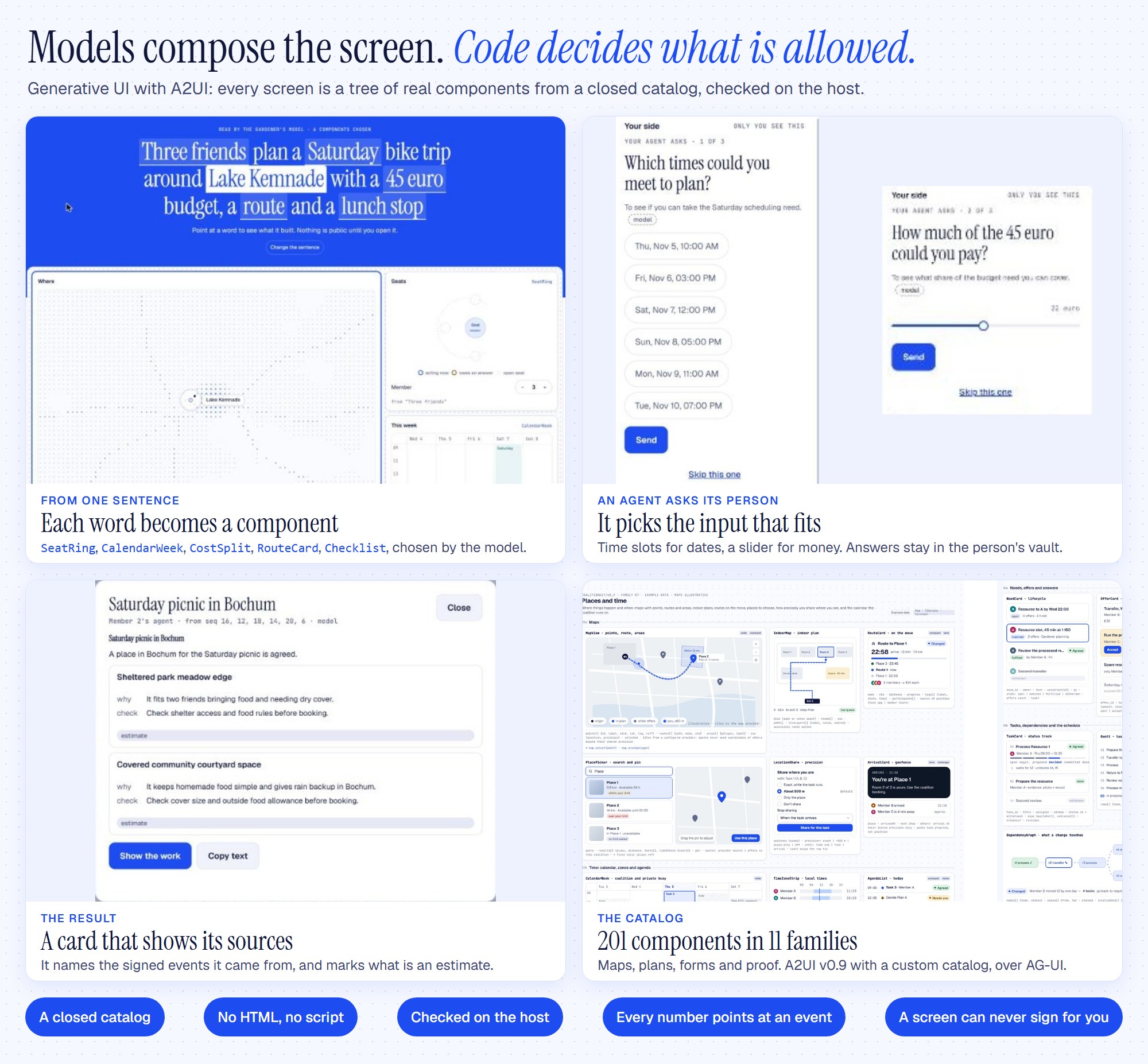
Screens are generated, but only from a fixed set of parts. A model chooses components from the catalog and fills them in. It cannot write HTML, script or styles.
Why it is closed
A generated screen is a place where a mistaken or tricked model could show something false or dangerous. So:
- A tree naming an unknown component is refused. Raw HTML is forbidden.
- The host validates every tree before it reaches a browser. If one fails, a fixed layout is used, or plain words.
- A number on screen is bound as
{value, event_ref}, pointing at the event it came from. - A tree can never answer a consent. Only the trusted consent path can.
The parts
The catalog has 201 components in 11 families, from text and forms to plans, maps and proof. It is A2UI v0.9 with a custom catalog, streamed to the browser over AG-UI.
A Discipline Pack can add views of its own, through its pack catalog.
Today in the room
The room's result layouts use seventeen of these. Seven arrange and label: Column, Row, Card, Heading, Text, Badge and Divider. Ten carry data: CostSplit for a budget, Checklist for a list, Timeline and Gantt for a schedule, Image for a picture, and KeyValue, Table, List, Meter and Deadline. Each is checked against its props in the catalog and against the result's data model before it is shown. A budget whose layout leaves out its CostSplit, or a list without its Checklist, is asked for again, then replaced by the fixed layout, which uses them too. Questions use input components such as ChoicePicker and Slider. The forming screen picks from a wider set, such as a map and a calendar. The rest of the catalog is available to anything that composes a surface, and you can see all of it at /gallery on a running host.